“Remember, you’re all lucky to be here.”
That raised a murmur from the crowd. None of us felt lucky, to be sure, stood there shivering in the muddy yard, breaths steaming in the predawn twilight. There were around a hundred of us, the new intake at one of the largest cherry orchards in New Zealand, and we were lucky, apparently, because the other orchards in the region had remained closed following days of rain since the start of the new year. We’d been on hold throughout those days, camped by the shores of Lake Dunstan awaiting the message for work to begin. A bumpy, early morning drive along miles of unsealed roads had brought us here, to a city of cherry trees out in the hills, row upon regimented row spreading for hectares in all directions. Somewhere above a helicopter circled, forcing downdrafts onto the trees to dry off the last residues of rain, impatient at nature’s unprofitable pace. And all the while our new manager was lecturing us on our fortune, his voice poorly concealing the mistrust he had of his new workforce. It would be the first of many lectures to come.
Orchards of this scale require organisation to extract full value at harvest. We were split off into teams of between twenty and thirty pickers, dispersing into the sprawling orchard like a marauding army. Our supervisor was a scrawny Brazilian lad with doe eyes and a fountain of frizzy hair, gentle and likeable but too sheepish to be wholly effective at leadership. Stalking the rows too was his quality control lieutenant, a straight-faced Argentinian who appeared wordlessly at the foot of ladders to rummage around in buckets and toss away what wasn’t up to standard. Two German girls acted as bucket runners, driving leisurely around on a quad bike like an elderly couple on a Sunday outing. Their role was to replace our filled buckets with empty ones, ensuring we could progress seamlessly with picking (this was achieved to middling degrees of success). The cherries were unceremoniously dumped into a trailer and periodically hauled off to the packhouse for closer quality inspections.
Then there was us, the mass of pickers on a broad spectrum of experience. Some, like another Argentinian on our team, followed the harvest professionally, leapfrogging the equator twice a year like a sinewave. He picked fast, fingers feeling for fruit while his eyes scanned ahead for new targets. But most were newbies like us, inexperienced yet undaunted by work that seemed simple in the abstract. For how hard could it be, really? We all we knew what a cherry looked like, after all.
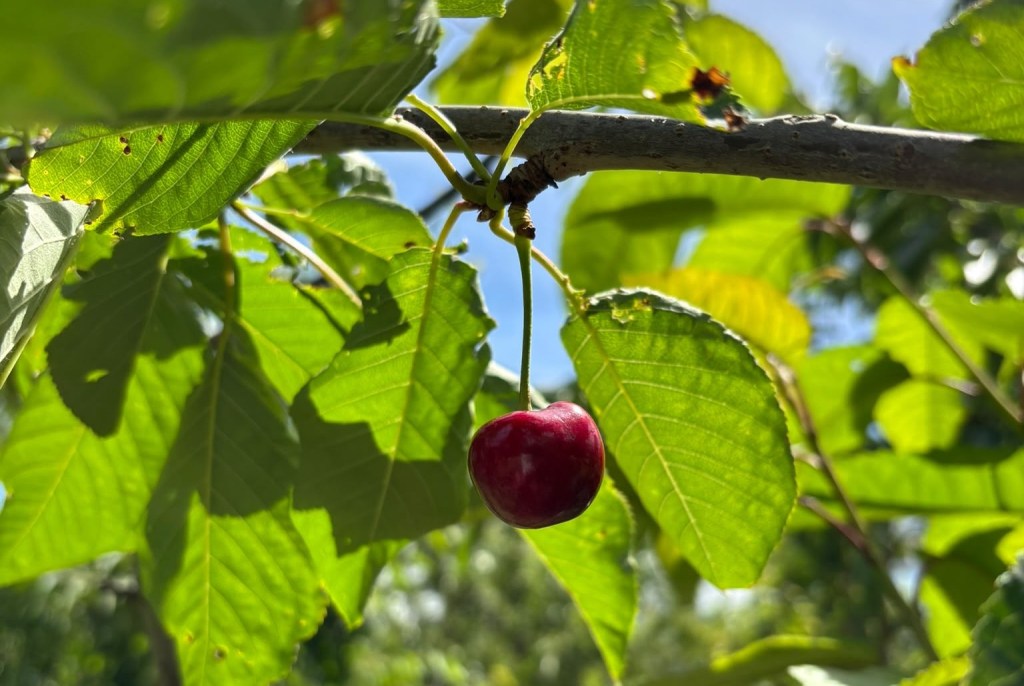
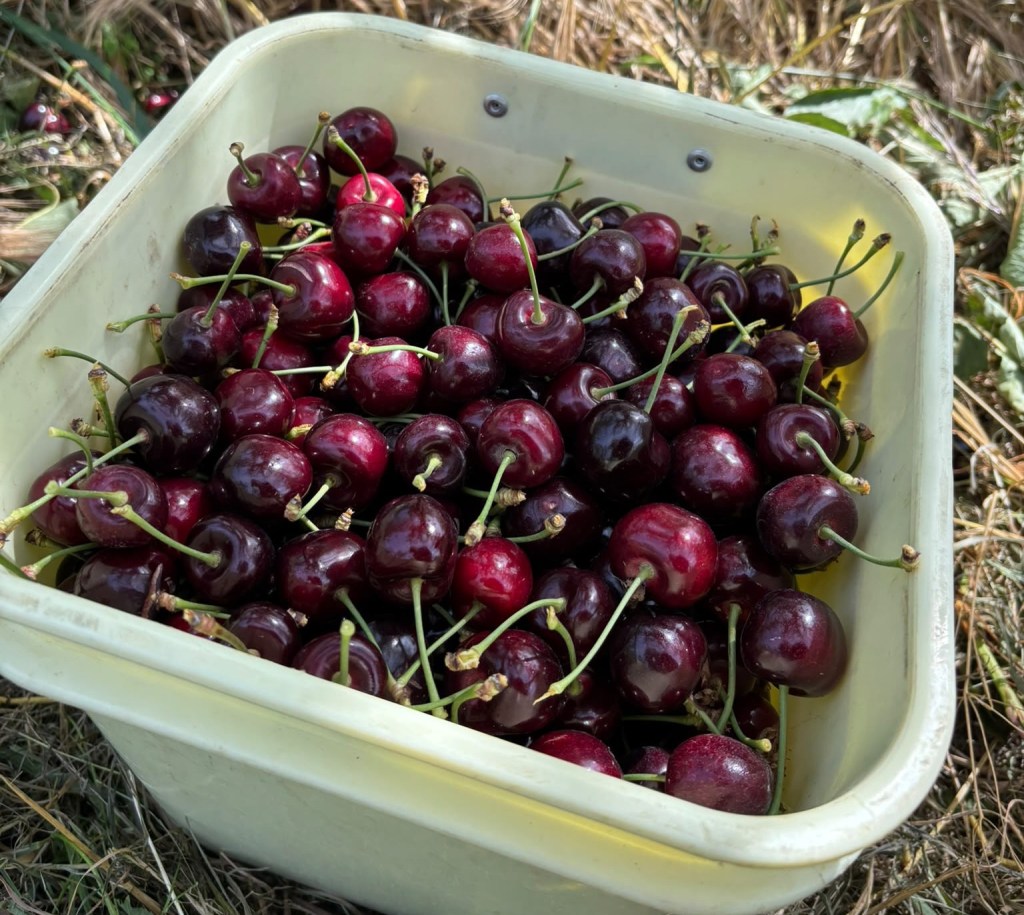
So off we went, ladders swinging wildly like a troop of slapstick comedians, clumping into the rows with our orders to skip any tree that wasn’t bearing good fruit. By smoko we were receiving our first comeuppance. The cherries we’d picked were “too red, too small” (this would become our motto, a mantra we’d chant in cultish unison). A handy guide appeared, somehow overlooked that morning, outlining minimum sizes the company expected us to pick. We drew circles on our hands with Sharpies to evaluate as we worked, giant circles that didn’t resemble any cherry I’d ever come across. Perfectly decent, tasty-looking cherries were held aloft as examples of absolute undesirables. The company wanted only enormous ones, of a deep hypnotic purple that turned ebony in the sunlight, suspiciously muscular specimens the likes of which I’d never seen in any supermarket, anywhere.
The problem was, such cherries were few and far between, and to pick only those would mean bucketloads of perfectly edible fruit (I should know, I ate them) risked going to waste. This wasn’t deemed a problem, however. If the cherries weren’t swollen and purple they should be skipped, in theory so they could plump up before someone else came along to pick them. In practice, the high standards meant huge quantities were abandoned to rot on the trees. Besides, the rain had already left much of the yield stunted or splitting or coated in a snowy mould. There was no worse experience than wedging your hand into a thick cluster only to discover brown and rotting mush.
The company actively promoted competition. Other teams were rivals, and even internal oppositions arose. Warnings had been explicit from the start: if we didn’t pick a specific number of buckets per day (the number forever fluctuated) we were unprofitable and would be fired. I knew I struggled with pace from our previous job as raspberry pickers, so this explicitly cutthroat environment felt immediately toxic. I rarely managed to breach the quota, and marvelled initially at others who quickly mastered up to thirty buckets per day. There was a distasteful machismo to the whole thing, with rumours abounding of expert teams dropping up to a hundred buckets each per day, wizard pickers competing for personal bests like elite athletes. Whether myth or fact, it benefited only the company, for it instilled in us all a feeling of isolation and insecurity. Breaktimes were a mess of eavesdropping, everyone assessing if they lay above or below average. Some obviously relished the chance to boast aloud of their numbers, and it annoyed me how inadequate it made me feel. Ash was quicker, but since we came as a team it only took one of us dropping below standard (me, inevitably) for us to both be left without income again.
But the weeks passed, my pace increased (though rarely to the level demanded), and still I clung to the job. It wasn’t as though the threats had been empty, either. Faces were disappearing quietly from the team, there one morning, gone the next. The patently slowest went first, those hardest to justify staying on, but then it became those who were simply below average, the camp I knew I’d settled in. Ash and I crunched some numbers and circled a date before which it made no economic sense to quit. The obvious solution might appear obvious: just pick faster? So I thought too, early on. Yet morning after morning I’d begin with a determination to set my pace aright, only to have fallen behind by lunch, resigned and hopeless by the close of the day. Things made more sense when I paid attention to how the quickest were actually hitting their numbers. Sly glances into buckets and a few pointed questions established that strategy and wile were essential. The bottom and top layers of the bucket should be good quality to avoid detection, but the rest could well be garbage and it would fly easily under the radar.
This of course pointed to a resounding flaw in the entire system. Jobs were being lost because of pace, yet the feedback we kept receiving was that quality was too low. Those who picked fastest were secure in their jobs, but in order to pick fast they often resorted to picking the tiny, stunted, split fruit we’d been explicitly warned to avoid. Management came out repeatedly to lecture us, yet nothing concrete was done to clamp down. Once I understood that it was not in my interest to care about quality – that my job might even be at risk if I did – I began to cut corners like everybody else. Still, I could never bring myself to pick the mouldy or damaged or unquestionably nasty fruit, whether out of perfectionism or naïve honesty. My buckets therefore continued to fill slower than others’, my numbers remained uninspiring, and the threat of dismissal breathed ever hotter down my neck each day.
Home for the month was a nearby field colonised by vans and cars and tents. On approach it had the appearance of a small music festival, albeit with only the barest of amenities. A line of porta loos were our toilets, nauseating during periods of heat. Flanking them were a line of porta showers, which flooded often and achieved little balance between scalding hot and icy cold. A chilled shipping container served as a giant refrigerator, and a couple of marquees sheltered picnic benches for makeshift kitchens, each lined with sockets hooked up to a constantly humming generator. Among the hundreds that lived there, cliques and communities formed. These collated mainly around nationalities and languages, with French and Spanish dominating. We made a few friends and spent a few evenings in company, but claustrophobia and fatigue set in quickly. Prolonged heat spells turned the whole site to dust, but rain was the worst, the ground churning to a cloying mud under the spin of so many tires. The workday started at 6am, when the sky was often a pretty lilac and the hills were masked in shadow. We’d follow the convoy out of camp, windscreen steaming with condensation, bellowing C.W. McCall as we hurtled through walls of dust that rose like steam from the gravel.
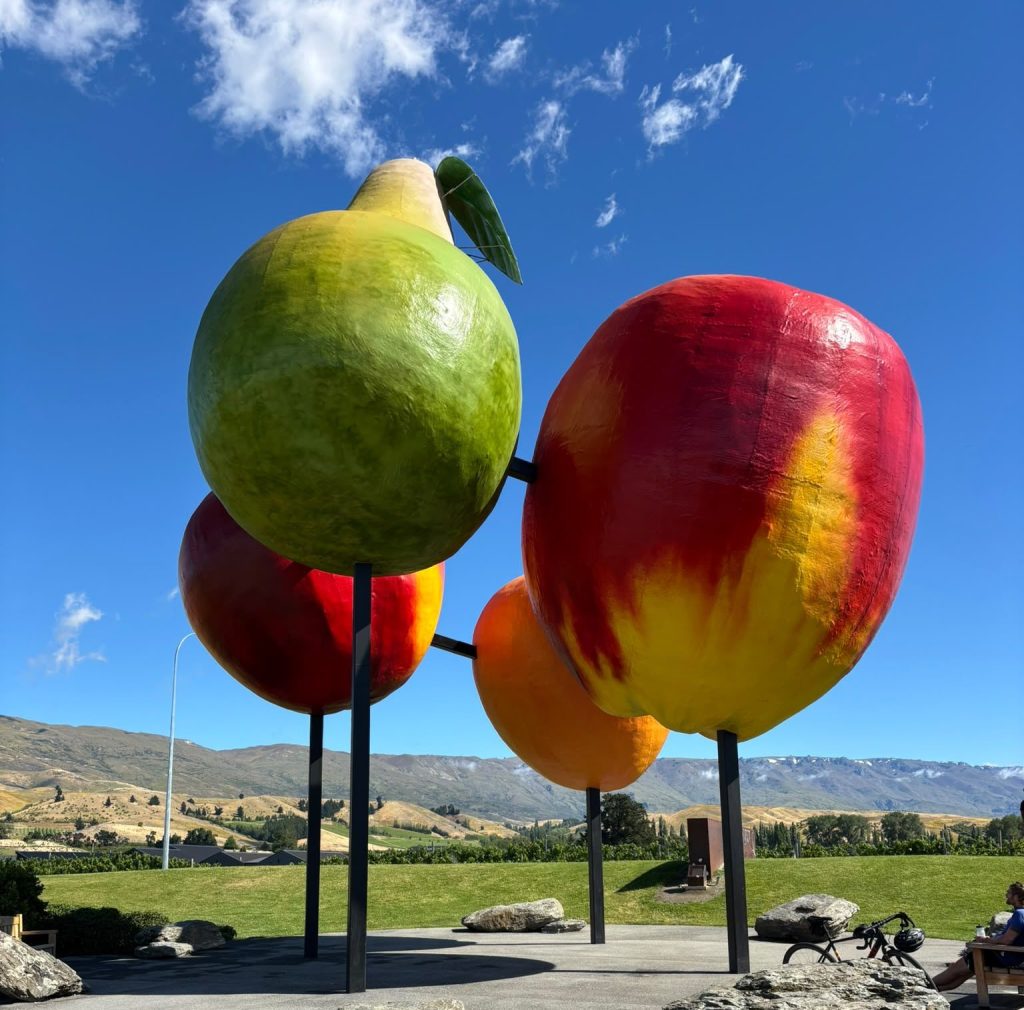
However long we lasted, our priority was straightforward: earn as much as possible to afford van repairs and our upcoming trip to Japan. With our first pay check we drove down the valley to Cromwell, a former gold mining hub now known as the ‘Fruit Bowl of the South’. The region’s dedication to horticulture is commemorated by four garish fibreglass statues that represent the various fruits of the region (cherries, surprisingly, not amongst them). In harvest season, on days when picking is cancelled, the town brims with workers running errands, usurping the library’s WIFI, or simply moseying around looking for something to do. We had more than the pleasures of civilisation on our minds, however. We’d booked Mitch into a garage to get his timing belt replaced and to resolve a possible oil leak. The cost was eye-watering, but the relief of driving off in a newly dependable vehicle just about made up for it. We resolved to pinch our wallets further, dramatically cutting back on groceries. Our bellies growled for much of that month, but we knew we’d thank ourselves for all those extra noodles in Japan.
Day by day the atmosphere at work grew less competitive. Setbacks brought us together as a team, beginning with the sudden and unexpected firing of our Brazilian supervisor. It transpired that his love for cherries was more than a professional passion – he’d been high most of the time on the job. It was no great shock to learn, as we’d all noticed him ambling through the rows dreamily picking out handfuls to eat. A clear case of the munchies, in hindsight. But he and the German bucket runners had suffered a falling out over his unique management style, laissez-faire on some days, autocratic on others. They’d reported his proclivity for a toke to management who had seen no recourse but to fire him. The bucket runners too disappeared without a trace, probably for the best.
No doubt the managers felt pressed into it, for in truth they liked to turn a blind eye to whatever was happening in the fields. We’d remarked early on how hygiene and health and safety rules were not enforced. Pickers hung precariously off ladders with joints dangling from their mouths, and hands filthy from carrying the ladders pawed and rummaged at fruit all day long (despite our daily requests, hand sanitizer was rarely refilled in the increasingly horrifying porta loos). Tales came of a girl in another team who had fallen from her ladder, drawing attention to the absence of clear first aid protocols. All the while houndings continued about quality, even though a cursory glance at the trees would show the company’s expectations were unrealistic.
This hypocritic application of standards was already souring our relationship with management by the time our supervisor was dismissed. Our Argentinian quality controller stepped up and, after leading an awkward moment’s silence for our fallen comrade, he grasped the reigns of power firmly and actually allocated us rows. Enforced structure was welcomed, and relations within the team began to defrost. Competitors became co-workers, nationalities intermingled, and previously unshared doubts about the aptness of our employer began to percolate. In some cases pickers started to work explicitly against them, deliberately filling their buckets with bad fruit, infatuated by those ever-increasing bonus quotas.
It all came to a head one glorious afternoon. We were filing out in a new corner of the orchard where the fruit was predictably uninspiring. A small bald man – presumably another manager – roared up on a quad bike seething with rage and shrieked, “Everybody put down your fucking buckets and go home”. He sped off in a cloud of dust leaving us stood there, blinking and baffled and bemused. We gathered around our leader, who was frantically radioing the packhouse for clarity. Then, like unchecked schoolchildren in an unsupervised classroom, bedlam ensued. I don’t know who threw the first cherry, but buckets turned into barrels of ammunition and small red bullets began to ping back and forth. We took cover amongst the trees, not least because the dirt roads now filled with dangerously speeding and overloaded quadbikes like something from Mad Max. Confirmation broke through eventually – we were done for the day, perhaps even for the week. Despite the gorgeous weather, the orders were plain: stop picking and leave immediately.
Our month with the multinational cherry company was in striking contrast to the month we’d spent in Ashburton. We’d experienced first-hand the difference between a locally-owned and community-entwined business and a faceless corporation helmed by investors whose sole intent was profit. It struck me that the latter, though vastly larger, was far less effective as a business model. From the very beginning it was clear that the managers did not trust the workers, and so in turn the workers learned to distrust the managers. A culture of competition backfired, the culture of picker-against-picker morphing into one of solidarity amongst co-workers. And the staggering scale of the orchard was such that gluttonous waste was unavoidable and individual workers saw their own actions as inconsequential against a wider, incomprehensible whole. Many were glad to see the season had been a failure for them, that a team of investors somewhere would be losing a lot of money. We didn’t care, because we’d been given no reason to care. We were all backpackers, of course, fortunate in that we’d find new jobs easily. Such is not the case for many across the globe, trapped in predatory wage-slave situations where massive corporations hold all the power and exhibit none of the accompanying responsibilities.
The explanations unravelled later. Over half of the cherries entering the packhouse had failed quality checks, and the company, realising it was haemorrhaging money, had panicked into shutting down to save on wages. A professionally worded message came through on the campground WhatsApp, outlining in calmer tones that picking would resume after three days once the bad fruit had dissolved and good fruit developed. Most of the workforce had had enough though. Everyone knew dismissals were immanent, word being that whole teams would be laid off this time. Luckily, none of this mattered to Ash and I. The three days’ break had taken us past our target, and we grasped the chance to cut loose before we found ourselves among the rejected (no doubt I’d rode my luck long enough).
We tracked down our supervisor at the campground to announce our departure. In recent weeks he’d unveiled a delightfully warm personality beneath his stiff exterior; decked out in a Hawaiian shirt and swim shorts, he evidently relished the prospect of a few days off in the sun. He waved us away like a proud Dad as we drove off to Cromwell, chattering manically about the tailspin events of the day. In the mayhem of that final hour we’d befriended a ladder runner who lived in town with a housemate from Dundee. We went to his house for drinks, got merrily pissed with strangers and a muddle of skittish greyhounds, and toasted the floundering company in triumph. That night we slept parked in their driveway under the stars, and drove north the next morning, stomachs flipping with elation.
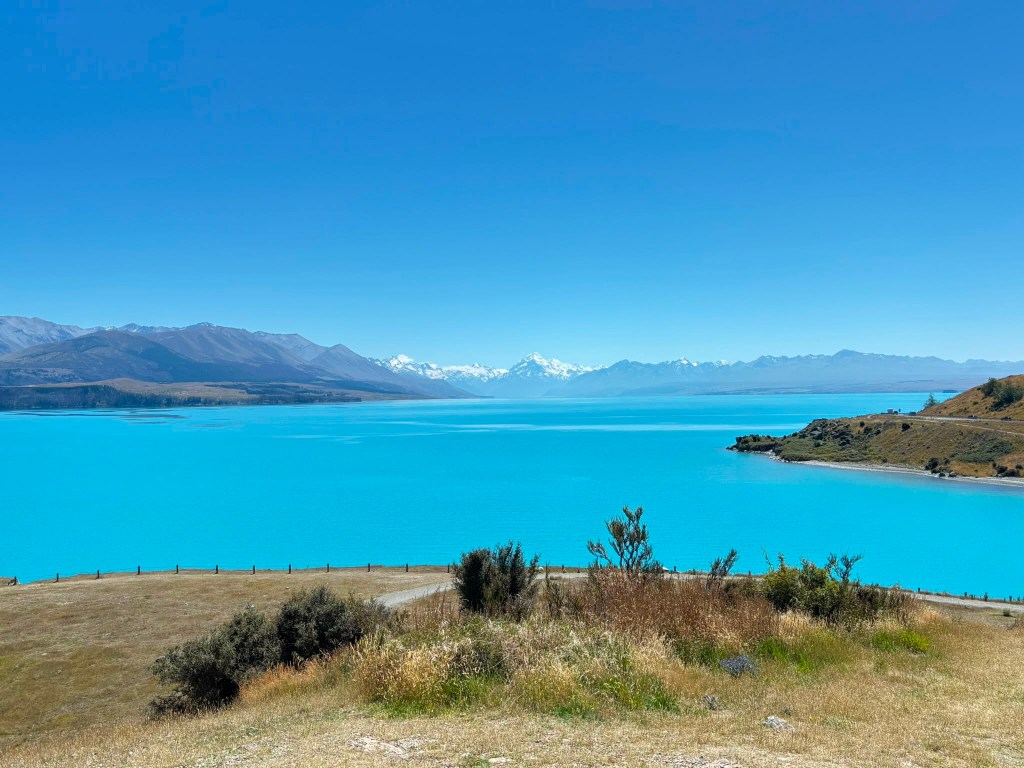
That evening we swam in the glacial waters of Lake Pukaki, gawping at a crystalline perspective of Mount Cook. We were keeping our eye on the campground WhatsApp, just to enjoy the gossip a little longer. Some were now semi-jokingly threatening to riot at the campground (French, most likely). We envisioned a scene of porta loos upended and marquees on fire, utter anarchy ensuing. Others had submitted pictures of themselves to the company app, squatting bare backside over brimming buckets of cherries. Astoundingly, the photos had still been accepted by quality control, evidence enough that their overstretched efforts at maintaining accountability were miserably inadequate. We chuckled about it before leaving the group, and with it that chapter of our travels.
Had we been lucky to be there? Definitely not. Still, it was a month we’ll always remember: a month of anecdotes and absurdities, of lessons in how not to run a business, and, above all, a strict reminder to never neglect washing your fruit.


Leave a Reply