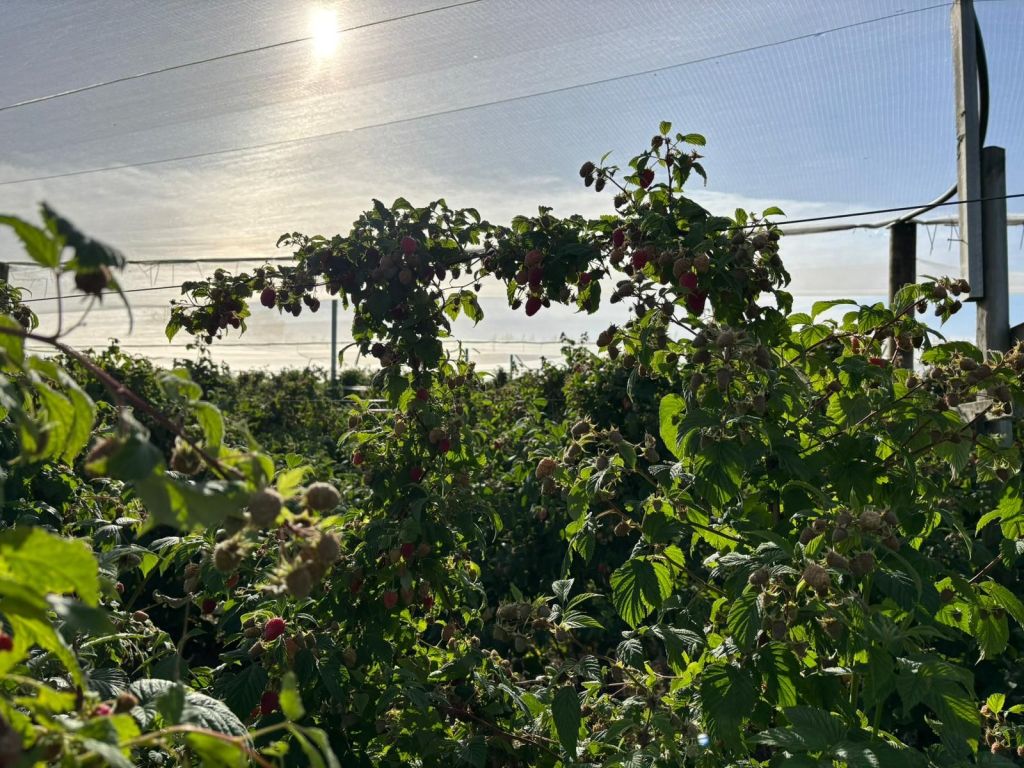
There would be mornings where the sun cast long shadows down the rows and dewdrops formed around the raspberries like crystals. But the air would warm quickly, stirring to life with birdsong and insect clicks as we lugged our crates of plastic punnets along those green lanes in silence. I tried to pick strategically, approaching the bush from both sides, squatting to check beneath the folds, ducking to scan the back. The berries gathered in a basket at my waist before being transferred to the punnets, sieving through fingers that pried for mould or rot or imperfections. So I’d proceed along the row, clearing bushes and lining crates until the heat was at its highest and the sun was curving far across the sky. Full crates went to the packhouse for weighing, new rows would be allocated, and the process would begin again, repeating until late afternoon or the day’s quotas were filled. When the berries were good – when they slid effortlessly off the cane, ruby-red and tough and plump like sweeties – then the work was a pleasure. On days like that, I felt I could pick for hours.
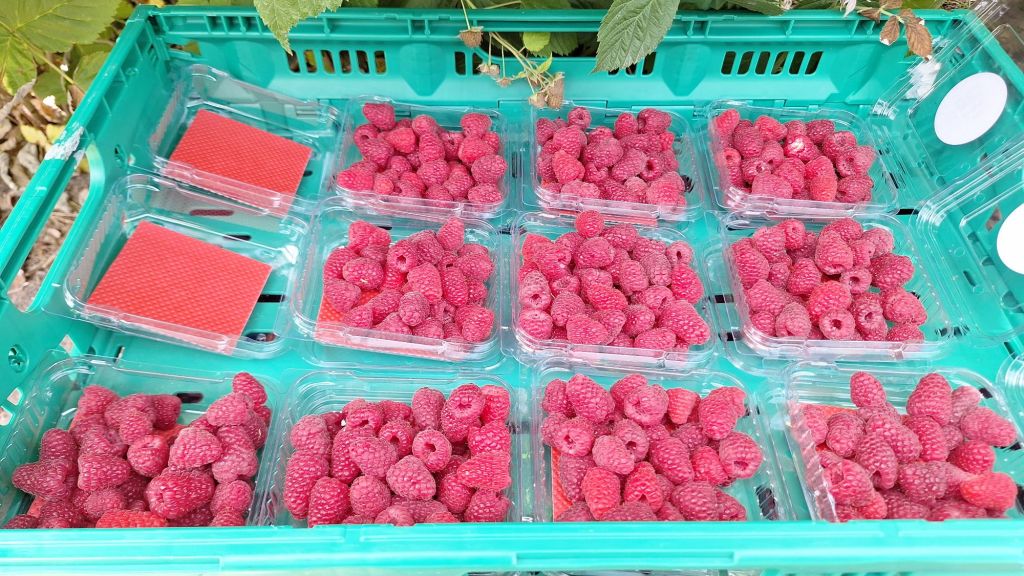
Of course, they weren’t always like that. Conversations kept returning to the unseasonable rains we were having, causing havoc with the harvest. Vicious storms would blow in across the Canterbury plains, forcing us to cower in the van as black skies flashed a spectral white and thunder snarled overhead. Many mornings I’d wake to rain drumming the roof like impatient fingers, and I’d know that picking would be postponed and I’d be in limbo until the bushes were dry. Raspberries are fragile; wet raspberries turn to mush; and while the juiciest fruit could still be collected for jam, this paid less per kilogram and wasn’t in high demand. After days of moisture the berries would become robed in fluffy dressing gowns of white mould. Those were the worst days, when we scraped what fruit we could from the canes but had to toss most of it away – dispiriting and unproductive work.
So passed our month in Ashburton, an agricultural town south of Christchurch that muscles its way into few guidebooks. We lived in our van in a paddock by the orchard, showered each evening at the local recreation centre, and passed our free hours in the town’s library. We were the only backpackers to begin with, the rest of the workforce being either Filipino families or local kids just trying to earn some beer money before the restart of university. As a result, within days of our arrival Ash was promoted to the shopfront, becoming de-facto Mother Hen to the flock of teenage girls who staffed the packhouse. I managed one shift in there working quality control, before lobbying hard to remain in the fields, preferring the sun-soaked strain of picking to tedious, repetitive work indoors.
Weeks went by without us leaving town. My days off came with the rains (so long as it was dry, work was available), but even during the worst spells Ash was required for the shop. I spent those days alone, running errands or sitting in the library: reading, writing, watching the clouds, waiting for work to resume. After weeks on the road we relished the chance to live quietly and cheaply, directing our incomes towards groceries, laundry, and our looming trip to Japan (booked in Rotorua when we’d still thought our jobs there were long-term). The sometimes snowy mountains did draw our wistful gazes now and then, but for the most part we were content to defer their exploration, welcoming this little charade of normalcy for a while.
Plus, I actually enjoyed the work, and gained a decent enough reputation as a picker since I couldn’t bear to pick what I wouldn’t eat myself (a naïve approach that served me poorly in our subsequent job). Bad berries were in abundance though, and even the half-decent ones were sometimes impossible to reach through stubborn thickets and unyielding branches. Many failed to ripen for lack of sunlight, and would cling meekly to the cane, pale pink and stunted. The managers were soon descending on the fields, bemoaning the bad fruit making its way into the packhouse. Spot-checks were ramped up, and I witnessed a few bollockings for the worst offenders, some of whom would be laid off. More backpackers came in as reinforcements, forming a little neighbourhood on the paddock: a mischievous Berlin hippy; a surly French foursome who preferred their own company; a startled Uruguayan couple who seemed permanently baffled by the circumstances they’d landed in.
Though I may have been consistent in quality, I always struggled with pace. We were expected to pick at a rate according with our hourly minimum wage (I could never grasp the calculations that determined this). But speed was reliant on a few variables: the abundance and quality of the fruit; the ever-temperamental weather; and the inconsistent maintenance of the rows. When all of these were in our favour, it was easy to see how averages could be increased; but when the inverse was the case – when weather and berries and row were all bad – then no matter how efficiently I tried to pick, I never could reach a pace where the company wasn’t losing money on my labour. This wouldn’t normally have bothered me, but the managers were fair with us and their stress was infectious. There were days I’d have taken a slight pay cut just to avoid the constant pressure of having to pick faster than what the reality of the harvest made possible.
To top this off, Mitch decided to throw a tantrum on us, possibly a defiant response to our newly stationary lifestyle. It began with an angry flashing of his orange engine light, then escalated to a petulant throttling when he sat at idle, trembling and rattling his whole chassis in rage. We steered him tentatively to the only garage who would see us at short notice, only to be met with ill-disguised condescension. The mechanic diagnosed a vague problem, made a quick fix to stop the revving, then recommended an imported part of unknown provenance at a cost of hundreds of dollars. When we pressed for clarity we were met with barely stifled smirks, and were hurried away none the wiser about either the problem or its solution. At a colleague’s recommendation we saw another mechanic in Allenton, who expressed bafflement at the ‘fix’ we’d been charged and, securing his merit in our eyes, inspected the van for free. He eased us with an assurance that Mitch – besides a short temper – was running in good condition and that new parts were inessential. Though mysterious, the revving amounted to a mere inconvenience, not a cause for concern.
The season peaked the week before Christmas, the people of Ashburton descending in droves to collect their pre-orders of raspberries for the traditional festive pavlovas. Ash was on the frontlines, dealing patiently and admirably with their festive ire; but we all tapped into some collective flow state, whisking berries from bush to punnet in record time. We’d felt little of the Christmas spirit ourselves, bemused by carols and decorations in weather that begged for burgers, not chestnuts, on open fires. In fact, we’d suffered our first sustained bouts of homesickness, imagining family and friends settling into cosy routines without us. For that week alone I’d have traded a kiwi summer for a touch of winter bleakness and a blanketing of hoarfrost. For a day or two, at least.
Our managers kindly offered to host us for Christmas dinner, but we agreed some time away would be better. We drove up to Akaroa, a beautiful harbour town on the Banks Peninsula, jutting into the Pacific Coast below Christchurch like a pinwheel. There we spent a peaceful if unusual Christmas, simulating a roast dinner on the gas hob, sipping beers in blistering heat, playing a rented boardgame called Viticulture. Our homesickness was offset by calls with loved ones and by the blue harbour water and the enveloping high green hills. Akaroa has a unique heritage as a failed French colonial venture. Some fifty settlers arrived here in 1840 from Rochefort, only to discover that the signing of the Treaty of Waitangi meant New Zealand was now considered to be under British sovereign rule. The settlers chose to stay, preserving their culture in the street names and distinctly Gallic ambience that contrasts with the rest of ever-so-English Canterbury.

Though we’d planned to remain in Ashburton until the end of January, it was clear upon our return that we’d have to change plans. I picked my final row on the last day of 2025, finding along its length few things resembling raspberries. The bushes were finally barren, the rains having delivered their fatal blow. Our managers accepted our decision to cut loose, and we all shared some farewell pints to celebrate the season’s end (the packhouse girls enjoyed a Diet Coke). We headed to Timaru for New Year, known for its little blue penguins that wash in on the nightly tide and pose for gushing tourists before scurrying away to the rocks. The fireworks were well attended and as extravagant as any local display should be, but we were somewhat muted in toasting ‘Auld Lang Syne’ to nought but our two selves.
Next up was Central Otago, where we’d secured work on a cherry orchard to see us through January. All we had to do was get there, in a tetchy van that no longer seemed quite so reliable as before. Mitch had recently surpassed the 200,000km mark (mostly acquired from a previous life as a scaffolder’s van), which meant a replacement timing belt was due. We’d become paranoid after misdiagnosing a rattly handbrake (compounded by the revving) for a moribund engine, and now every buzz or shudder felt like a prewarning of some sudden and horrific explosion. If Mitch decided to show his displeasure now by chewing up the old belt, the engine would be irreversibly buggered and we’d be without both van and home. So it was with bated breaths and crossed fingers that we hit the highway again, cutting inland towards the tussocky mountains and borrowed placenames of Central Otago – a mirror image of the home we’d left some six months before.


Leave a Reply