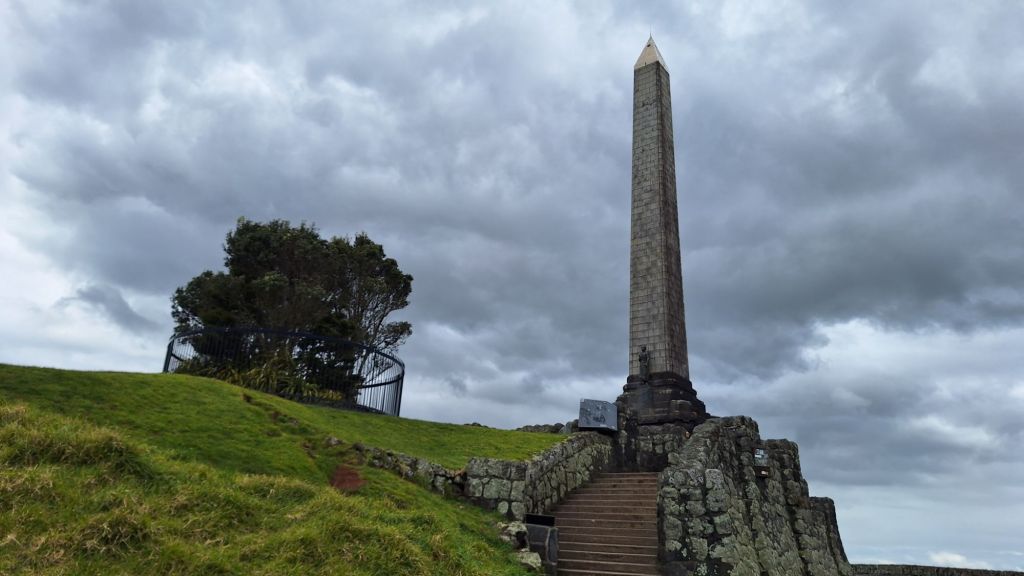
It’s easy to understand how a bustling settlement could have existed on Maungakiekie. Buildings, food stores and plantations would once have lined the artificially terraced slopes and the extensive views from its summit would have made it easily defendable as a fortress. Maungakiekie was once the largest pā in the Auckland region, with thousands living and working on its slopes. Now, like Maungawhau, it is more monument than settlement, a protected Tupuna Maunga (ancestral mountain) of the Tāmaki Māori.
Maungakiekie earned the English name ‘One Tree Hill’ because a single tōtara tree stood on its summit. The tōtara was cut down by a pākehā (European settler) vandal in the 1850s and replaced with a non-native pine by Sir John Logan Campbell, Scottish-born mayor of Auckland. This, in turn, was vandalised in the 1990s by a Māori activist, and for years no tree stood on the top of One Tree Hill. Only in 2016 were nine native trees replanted on its summit.
Still, Maungakiekie is dominated not by any tree, but by a human-made obelisk, erected by Campbell as a memorial to the Māori people he incorrectly assumed would soon become extinct. Campbell is buried beneath his obelisk, which appears to commemorate his benevolence as much as it does the unnamed natives he was purported to have loved. It’s hard not to read significance into the fact that the tōtara and pōhutukawa growing here will never not be overshadowed by this explicitly non-native monument.


Leave a Reply