Upon first impressions, it’s hard to imagine what could attract a celebrated European architect to Kawakawa. The small farming town seemed distinctly unremarkable when we passed through on our journey around Northland. The Klondike Ale House, bare walled and unadorned save a few faded posters and the reverently updated rugby fixtures, served us pints of Lion Red as we took our seats amongst the town’s gumbooted workforce. The starkness of the bar contrasted with the glittering allure of the gaming lounge, a shadowy fixture of every Kiwi working-man’s establishment seducing the inebriated with promises of quick riches and even quicker escape. The glamour of its Vegas skyline wallpaper was in ironic opposition to Kawakawa’s dusty main street beyond the open window.
Despite all it’s uncosmopolitan charms, Kawakawa and its surroundings were once home to famed Austrian architect Friedensreich Hundertwasser, designer of buildings from Vienna to California and author of the ‘Mould Manifesto against Rationalism in Architecture’. The community seems mostly bemused by the legacy of this foreign eccentric, resident from 1975 until his death in 2000 – especially since his lasting contribution was an idiosyncratic public toilet.
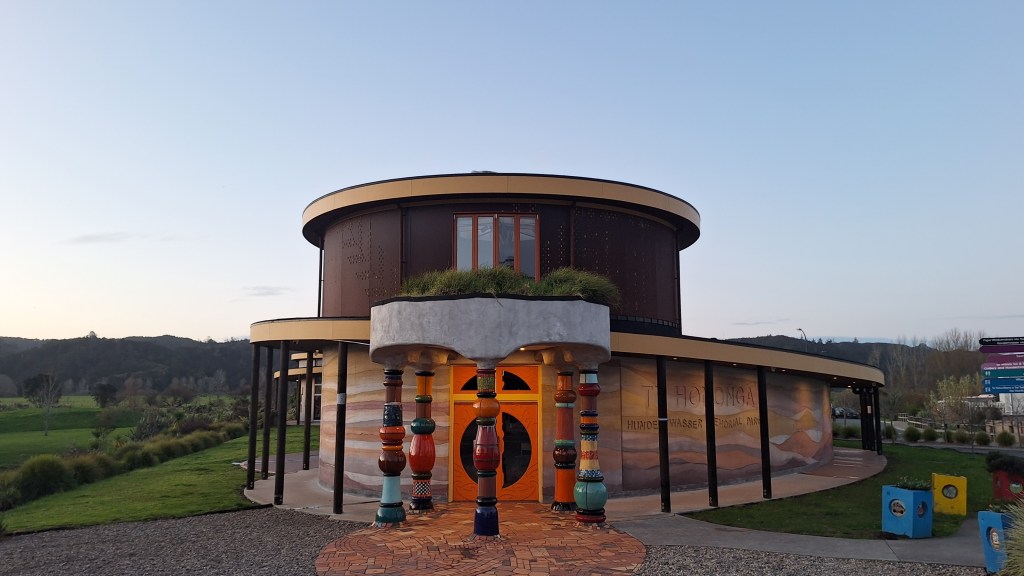
The Hundertwasser toilet bears all the hallmarks of his style: an obsessive disdain for straight lines, embrace of diversity in colour and shape, and commitment to sustainability evident in the tree ‘tenants’ sprouting from the roof and recycled glass bottle windows. We’d already encountered his work in Whangarei, noting his indebtedness to Antoní Gaudí. But while his wobbly aesthetic was incongruous with Northland’s otherwise drab capital, the Kawakawa toilets were a clearer expression of his philosophy of a living, joyful and democratic architecture.

Hundertwasser’s love for New Zealand might be understood by looking at the country’s buildings. We had seen few housing estates during our travels, unlike back home where most homes resemble every other within a mile radius. In new-world frontier fashion, empty plots here were bought and sold for development, resulting in mish-mashes of design, layout and colour. Hundertwasser decried people’s alienation from their own homes, declaring “every person should be allowed to build (and ought to build) . . . the four walls within which [they] live.” There would be errors, sure, but rarely fatal ones (or so he believed). Perhaps what Hundertwasser found in New Zealand was a freedom and creativity missing from cheerless, rational Europe, where modernist developments had turned beautiful cities into brutalist towerblock cemetries.
The Kawakawa toilets may be a tourist attraction, but they remain primarily a free-to-use public utility, to be admired, photographed, and defecated in. They are deliberately anti-elitist, as all meaningful art should be.
Sources
Mould Manifesto against Rationalism in Architecture – https://www.hundertwasser.at/english/texts/philo_verschimmelungsmanifest.php

 Dead Academic
Leave a comment